


Research

RESEARCH STRATEGIES, LINES AND PROJECTS FOR THE ACADEMIC YEARS 2026-2028
The Department of Communication and Performing Arts includes among its members professors belonging to four different Faculties (Humanities, Foreign Languages and Literatures, Education Sciences, Political and Social Sciences) and five different disciplinary sectors related to three research areas (10/PEMM-01/A and B; 11/PHIL-04/A and B; 14/GSPS-06/A). This exhibition is divided into two parts. The first presents the general activities and strategies of the Department, the result of the joint work of its members. The second shows the files relating to each research project underway in the next two years, grouped by scientific-disciplinary area; In this case, an introduction highlights the transversal lines between the different research sites.
PART ONE. THE DEPARTMENT'S RESEARCH ACTIVITIES AND STRATEGIES
Given its history, which began at an early stage of scientific studies on entertainment, media and communication in Italy, the Department has always moved in a profoundly interdisciplinary perspective, developing research initiatives, collaboration, construction and participation in national and international networks, and publication of results in terms of national and international visibility. This first part of the report will highlight precisely these different aspects of the department's work.
1. Research support initiatives
Beyond the research of individual professors and researchers and the spontaneous collaborations, both intra and inter-faculty, that are created between them, the department promotes opportunities for research and sharing of research results through:
- the promotion of research of interest to the University involving as many students as possible (described in the second part);
- support for national and internationalpublic call searches (described in the second part);
- the planning of moments of exchange and discussion of ongoing research (including those of visiting scholars and PhDs): the so-called "Department Cafés";
- the organization of Departmental Meetings and Seminars, also related to research in the individual areas and the presentation of volumes, as well as networking with other national and international working groups;
- the planning of some training meetings for doctoral students of the various doctorates and of the various UC doctoral schools who want to focus on topics relevant to those of the department on the theme of their studies.
2. National and international collaborations and research networks
The department offers an intense reception of visiting professors, visiting scholars and visiting phds; this is regulated by means of a special regulation approved by the Council and following the indications of the "Regulations for the conferral of visiting professor appointments" (DR 1549 of 18/07/2025): in particular, visitors are invited or accepted after a selection by the Department Board and given the entrustment to one of the professors of the Department who becomes the organizer and guarantor of the study and training activities in which the visiting will be involved.
The department promotes the creation and participation of its professors in national and international research and exchange networks, as well as disciplinary associations:
- CUC University Council of Cinema https:// www.consultacinema.org/
- CUT University Theatre Council https://www.consultauniversitariateatro.it/
- AIS Italian Association of Sociology https:// www.ais-sociologia.it/
- AISS Italian Association of Semiotic Studies: https://www.associazionesemiotica.it/
- VISUS Association for Visual Culture Studies: https://associazionevisus.org/
- PIC Cultural Processes and Institutions https:// www.ais-sociologia.it/processi-ed-istituzioni-culturali/
- SISCC Italian Scientific Society for Sociology, Culture, Communication https://ssi-scc.it/
- NECS European Network for Cinema and Media Studies https://necs.org/
- The department is also a collective member of ECREA, European Communication Research and Education Association https://www.ecrea.eu/
The Department promotes the participation of its members in disciplinary and interdisciplinary, national and international conferences (described in the second part) and participation in national and international doctoral colleges.
The department adheres to the PhD Programme Media and Communication, in partnership with the Institute of Communication Studies and Journalism, Faculty of Social Sciences, Charles University, Prague (https://iksz.fsv.cuni.cz/en/admissions/phd-programme-media-and-communication-studies ) and the "Italian Conference of Sociological Area Departments (CIDAS)"
3. Publications
The department promotes the publications of its members, and in particular – in synergy with ALMED – the journal Comunicazioni Sociali Journal of Media, Performing Arts and Cultural Studies – whose issues can therefore be published in open access. It also helps to finance other publications, including the class A magazine for area 10 L'Avventura (Il Mulino ) and the proceedings of the final conferences of doctorates and doctoral schools belonging to the Department.
Of particular importance is the open access publication policy, to which the department has dedicated and will devote educational and economic energies over the next three years.
In recent times, the quality of publications has become increasingly important, also in terms of recognition by the appropriate institutions or evaluation agencies. In this sense, the members of the department have made a significant contribution to the good VQR evaluation, in the various disciplines in which they have presented themselves and participate in the initiatives to promote the university more and better in the various international surveys related to rankings.
4. The Department and the University Institutions
The Department is at the service of the faculties to which its members belong and of the related doctorates and doctoral schools through the promotion and organisation of research and research training activities in the media, communication and entertainment sectors.
It also collaborates with the research centers that have derived from its activity: OssCom - Research Center on Media and Communication; Ce.R.T.A., Research Center on Television and Audiovisuals; CIT, Centro di Cultura e iniziativa teatrale "Mario Apollonio"; ARC, Centre for the Anthropology of Religion and Generative Studies) for the organization and publicity of activities and events; and with ALMED, Graduate School of Media Communication and Entertainment.
Finally, given its interfaculty nature and given the particular object of its research, the Department also intends to perform a service to the entire University by promoting a culture of media, communication and entertainment through collaboration with other departments and research centers, as well as through the organization of specific events and meetings aimed at professors, researchers and students of the University.
PART TWO. RESEARCH PROJECTS FOR THE TWO-YEAR PERIOD 2026-2028
There are 70 research projects surveyed for the next two years. The forms of funding (in some cases complementary) are: D.1 Università Cattolica (37 projects), D.3.2 Università Cattolica (9 projects divided between: Utopias, dystopias and media narratives with 1 project, Communicating science with 5 projects, XLearning with 2 projects, Imperfect strangers with 1 project), Prin projects (34 projects), Erasmus+ and Horizon Europe projects and other international networks (4 projects), External orders of various types (34 projects).
The research areas are those on which the disciplinary competences of the department are articulated: Dramaturgy, theatre and rituals - performing arts (10/PEMM-01/A), Cinema, broadcasting and new audiovisual media - cinema, photography, radio, television and digital media (10/PEMM-01/B), Sociology and anthropology of communication and media - sociology of cultural and communicative processes (14/GSPS-06/A) and Aesthetics and semiotics of media discourses - 11/PHIL-04/A and Btag.
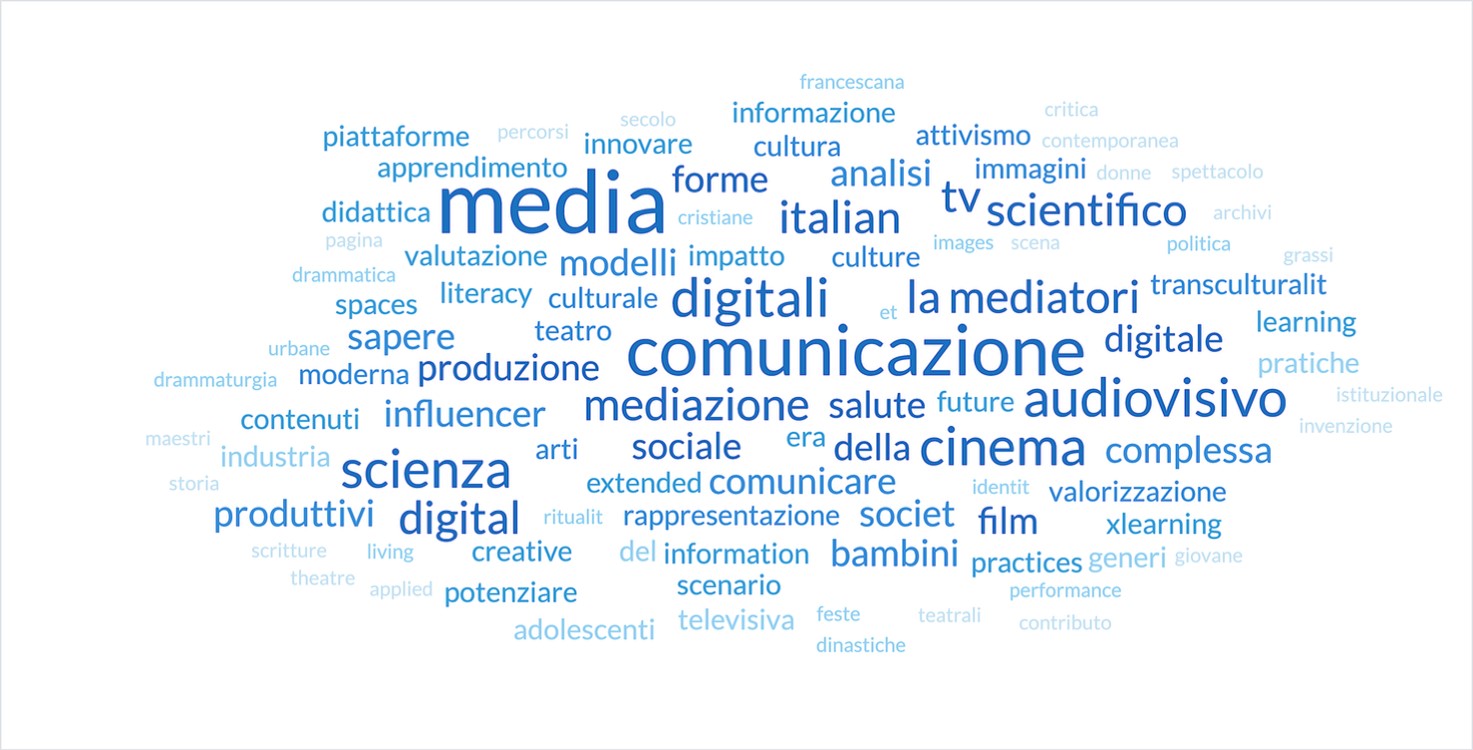
The topics of the research are differentiated but evidently united by the interest in issues related to communication, media and performing arts, as evidenced by the wordcloud derived from the titles of the researches:
Beyond the recurrence of these central topics, the projects are crossed by some transversal lines that reveal some overall strategic principles of the Department:
- Specific attention is paid to the relationship between images, media, representations on the one hand, and religious experience and culture on the other , both at the level of performative practices and audiovisual productions (Living images, Performance and rituality, MICS. Media, creative industries and religiosity today, Cine-tele-tourism and communication of the territory; Social Generativity and its Communication).
- Specific attention to the relationships between the media and marginal or weak populations that are found in the works on performance - media and health (Applied theatre: social theatre, theatre and health; Parenting, health, care: the role of digital media between platform economy and generative logics; Health, Communication, Media); Media and experiences of migration and transculturality (Performance: rituality, identity, transculturality, Paths of transculturality between institutional criticism, cultural activism, media and arts; Media and city); media and the elderly (Age-It: Active ageing, social capital, environmental sustainability and communication technologies); media and children or adolescents (Safe_you Digital Health-Digital Responsibility: Digital Guidance Academy for Young Leaders, Kids TV. Competitive scenario and production models of Italian children's TV, Parenting, health, care: the role of digital media between platform economy and generative logics; Children, adolescents and digital media; Theories and techniques of storytelling for the audiovisual product aimed at children), also with contributions from the third mission (Media literacy; Opinion Leader 4 Future. Informed information and orientation in society; Social Generativity and its Communication) and the study of processes of detachment from media "dependence" (Digital Disconnection)
- Specific attention to the enhancement of female contributions to representation and media that can be found in the contributions of dramaturgy and in those of cinema (For an enhancement of the contribution of women to the history of entertainment, Equity and Inclusion in Italian Cinema and Media, Gender balance in Italian Film Crews).
- A focus on the relationship between media, representation and forms of politics (Forms of political communication in urban and dynastic festivals in the modern age; Attribution, Perceptions, and Practices of Political Incivility in Europe; "Influactivism". The convergence between activism and influencer culture in the new digital ecosystems)
- The convergence, already reported, of various research groups with specific media skills on some University projects D.3.2 such as "Communicating science" and "Extended Learning. Innovating teaching, enhancing learning", "Utopias, dystopias and media narratives", "(Im)perfect strangers".
- The activation of a wide range of methodologies applied to the media sector also through collaboration with colleagues from other departments in the fields of cognitive and neurocognitive sciences, social psychology, historical and archival research, data science,
- The activation of a wide range of collaborations with external companies and institutions present in projects such as the impact assessment of the cinema law, the Opinion Leader 4 Future project . Informed information and orientation in society; the research on The production and international circulation of the audiovisual, on Production and consumption in the national audiovisual scenario, on Narrative rhetoric and the argumentative dimension of the screenplay, and various others.
- Internationalization: Horizon EU Kids and Young Researchers – Seal of Excellence (SOE) project.
